1-800-520-8201


So you've got a gold chain in your hand (or in your cart), and you want to know if it's the real thing. Here's the short answer: check the karat stamp on the clasp, check the weight against the chain's width and length, and check the price against the gold it should contain. If any of those three looks off, have a jeweler test it. An XRF test doesn't harm the chain.
And skip the float, vinegar and bite tests. They don't prove a thing.
Let's go through what actually works, what doesn't, and how to buy a gold chain online without guessing.
You will learn:
- Which checks tell you something, and which tests are myths
- What the stamp on a gold chain should say, and why a stamp alone doesn't prove it's real
- Whether a chain can be real gold without a stamp
- How much a solid gold chain should weigh
- Whether a hollow chain is real gold
- What a fake or plated chain looks like after some wear
- Which at-home tests work, and which are myths
- How jewelers test gold
- How to tell a chain is real before you buy it online
- Whether real gold tarnishes
- Whether white gold is real gold
- Answers to the most common questions
How Can You Tell if Gold Is Real?
You can tell if gold is real by checking three things you can see and weigh: the karat stamp, the weight for the chain's size, and any wear on the clasp and link edges. To actually confirm the karat, a jeweler has to test it.
Not every test is worth your time, and some will scratch your chain. Here's how they stack up:
| Check | What it tells you | What can fool it | Does it mark the chain? |
|---|---|---|---|
| The stamp | The karat the maker claims | A fake stamp | No |
| Weight for its size | Whether it's solid, against the listed weight of the same chain | A heavy metal hidden inside (rare in chains), or a lower karat | No |
| Wear at the clasp and edges | Plating wearing through | Nothing yet, on a new chain | No |
| Magnet | Catches iron and magnetic steel | Brass, copper, most stainless steel and other non-magnetic metals | No |
| Water (density) test | Whether it's far too light to be gold, at best | Hollow links, trapped air, a kitchen scale, a heavy metal hidden inside | No |
| Ceramic streak | A hint about the surface metal, at best | Thick plating | Yes, it rubs off a little metal |
| Acid test | The karat, at the surface | Plating, unless the tester files through it | Yes |
| XRF test at a jeweler | The metals at the surface | Thick plating over a different metal | No |
| Fire assay | The exact gold content | Nothing | It destroys a small sample |
Here's the thing almost nobody tells you: no test you can do at home proves a chain is solid karat gold. A home test can catch an obvious fake. Only a lab test can tell you exactly what's inside.
What Should the Stamp on a Gold Chain Say?
A real gold chain is usually stamped with its karat, like "14K," or its gold content in parts per thousand, like "585." On a chain, look on the clasp first, then on the little ring next to it, or on a small tag near the end.
Here's what the common stamps mean:
| Stamp | What it means | Gold content |
|---|---|---|
| 10K or 417 | 10 karat gold | about 41.7% |
| 14K, 583 or 585 | 14 karat gold | about 58.3% |
| 18K or 750 | 18 karat gold | 75% |
| 22K, 916 or 917 | 22 karat gold | about 91.7% |
| 24K or 999 | Pure gold | 99.9% |
If you want to know why 14K shows up as both 583 and 585, we cover that (and how much heavier 18K is) in our guide to 14K vs 18K gold.
You might also see "14KP." The P stands for "plumb," an old mark that once signaled a tighter standard. Today it doesn't mean the gold is any purer than plain 14K.
Which Stamps Mean the Chain Isn't Solid Gold?
These stamps mean there's gold on the chain, but not all the way through:
- GP: gold plated, a thin layer of gold over another metal
- GEP: gold electroplate, also a thin layer
- HGE: heavy gold electroplate, a thicker layer, but still plating
- RGP: rolled gold plate, a layer of gold bonded to a base metal
- GF, or something like "1/20 14K GF": gold filled, a thicker layer of karat gold bonded to a base metal
- Vermeil: gold over sterling silver
- 925 on a gold-colored chain: it's sterling silver underneath, with gold on top
And a stamp that just says "ITALY" tells you where the chain was made, not what it's made of.
Can Gold Be Fake if It Says 14K?
Yes. A stamp costs next to nothing to strike, and fake chains get stamped "14K" all the time. A stamp is a claim, not proof.
The US government doesn't test or hallmark jewelry. In the US, the stamp is the maker's or seller's promise. So if a stamp looks right but something else feels off, trust the something else.
And even a true stamp only tells you half the story. As I put it in our video on buying your first real chain: "A stamp proves karat, not construction. A hollow 14K chain stamps exactly like a solid one. That's why weight matters more than the mark."
Can a Gold Chain Be Real if It Isn't Stamped?
Yes. No federal law requires a gold chain to be stamped at all, and plenty of older chains, handmade pieces and repaired chains have no mark. A replaced clasp is a common reason, since the clasp is where the stamp usually lives.
If a chain you already own has no stamp, don't panic. Weigh it, look at the wear, and have a jeweler test it. If you're buying one, though, no stamp is usually a reason to walk away.
How Much Should a Solid Gold Chain Weigh?
A solid gold chain is heavy for its width, and a good seller tells you how heavy, in grams. Our product pages list the weight for each length, so you can see what you're getting before you buy.
Here's what some of our solid gold chains are listed at:
| Chain | 22 inches | 24 inches |
|---|---|---|
| 4mm Franco, 14k | 46 grams | 50 grams |
| 4mm Franco, 18k | 55 grams | 60 grams |
| 4mm Diamond Cut Franco (Italy), 14k | 48.5 grams | 53 grams |
| 4mm Diamond Cut Franco (USA), 14k | 36.4 grams | 39.7 grams |
| 5mm Miami Cuban, 14k | 43.5 grams | 47.5 grams |
| 4mm Hermes, 14k | 37 grams | 40.5 grams |
| 3mm Diamond Cut Franco, 18k | 33.5 grams | 36.5 grams |
These are listed weights. The actual weight can vary slightly from chain to chain (our listings allow for about 4% to 5%).
Look at the two 4mm Diamond Cut Franco chains. Same width, same karat, and at 22 inches the Italian one is listed about 12 grams heavier (48.5 grams against 36.4), because the two lines come from different makers. That's why you compare like for like: the same style, the same width, the same karat and the same length.
Pro Tip: A US nickel weighs 5 grams. A solid 14k 4mm Franco at 22 inches weighs about as much as nine nickels. If a "solid 14k" 4mm Franco at 22 inches weighs about the same as two or three nickels, something's wrong.
Why is gold so heavy? Because it's one of the densest metals there is. That's also why weight can't catch a gold-plated chain with a very heavy metal like tungsten hidden inside. That's mostly a problem with gold bars, not chains, but it's why a lab test beats a scale.
Is a Hollow Gold Chain Real Gold?
Yes, a hollow gold chain is real gold. It's made of gold tubing with an empty center, so it uses less gold and costs less than a solid chain of the same size. What it can't be is "solid." The FTC's Jewelry Guides say a hollow chain should never be called solid gold, and that hollow gold should be disclosed as hollow.
The trade-off is strength. As I wrote in our guide to diamond cut Franco chains, "The main concern with hollow chains is that they will break under stressful situations where solid chains would likely hold up." Hollow links also dent, and a dent in a hollow chain is hard to fix.
How to tell them apart:
- Weight: a hollow chain is much lighter than a solid one of the same width and length.
- Dents: solid links don't dent from everyday knocks. Hollow links do.
- The word "solid": if a listing doesn't say solid, ask the seller, and ask for the weight in grams.
What Does a Fake Gold Chain Look Like?
A fake or plated gold chain usually gives itself away where it rubs: on the clasp, on the edges of the links, and on the underside where it sits against your collar. Look for:
- A different color showing through on the clasp or the link edges
- Flaking or peeling
- A clasp that doesn't match the color of the chain (unless you chose a different metal or karat for it)
- Letters like GP, GEP, HGE or RGP next to the karat
- Words like "gold bonded" or "gold layered" in the listing, which mean a layer of gold over another metal, not solid gold
- A chain that feels light for its size
- Green or black marks on your skin or your collar (more on that below)
One important exception: white gold. White gold is usually plated with rhodium, a bright white metal, and when that plating slowly wears, you'll see a warmer tone underneath. That's normal, and a jeweler can re-plate it. It doesn't mean your chain is fake.
Which At-Home Gold Tests Actually Work?
A few home tests can catch an obvious fake, but none of them can prove a chain is solid karat gold. Here's what each one can and can't tell you.
The Magnet Test
Gold isn't magnetic. So if a strong magnet grabs your chain, the chain isn't solid gold. If it doesn't, though, that proves nothing, because plenty of cheap metals aren't magnetic either.
Pro Tip: Test the links, not the clasp. Many clasps use a tiny steel spring inside, and a strong magnet can tug on a perfectly real gold chain right at the clasp.
The Water (Density) Test
Gold is much denser than the metals used in most fakes, so in theory you can weigh a chain, measure how much water it pushes aside, and work out its density. In practice it's tough on a chain. A chain is small, air gets trapped between the links, and a kitchen scale isn't precise enough. A hollow chain will throw it off completely. It's a rough guide at best.
The Ceramic Streak and Acid Tests
Both of these work by rubbing or filing off a little of your chain's surface, so they mark it. And because they only test the surface, a chain with thick gold plating can pass them. We'd skip both and let a jeweler run a test that doesn't leave a mark.
Which Gold Tests Are Myths?
Some tests are all over the internet, and they don't work. Here's why:
- The float test: "fake gold floats" sounds good, but brass, copper and steel all sink in water too.
- Vinegar: real gold won't react, and neither will most fakes. When a gemologist tried it, nothing reacted at all.
- Toothpaste or baking soda: same story. Neither one tells real gold from fake.
- Biting it: teeth are harder than gold, so a bite can mark a soft 22k chain while a hard 14k chain may show nothing, and a soft fake can dent too. It proves nothing either way.
- A lighter: heating a chain tells you nothing reliable, and you can discolor it or damage anything set in it.
- The ice test: copper and silver carry heat even better than gold, so a fake can melt ice just as fast.
How Do Jewelers Test Gold?
Many jewelers and gold buyers use an XRF tester, which reads the metals at the surface of your chain without scratching it. It's fast and it doesn't leave a mark. Some still use acid on a touchstone, which leaves a tiny streak on the stone and a small rub on your chain. Refiners use a fire assay, which is the most accurate test there is, but it destroys a small sample, so it isn't used on a chain you plan to wear.
Not sure where to go? Any established jeweler, gold buyer or refiner can usually test a chain. Just ask first whether the test will mark it. And know that an appraisal (for insurance) and a gold buy (when you're selling) are two different services.
How Do You Know a Gold Chain Is Real Before You Buy It Online?
You can't hold a chain on a website, so the listing has to do the talking. Before you buy a gold chain online, make sure the listing tells you:
- The karat, written right before the word "gold," like "14K gold." (The FTC's Jewelry Guides say a gold alloy should be described that way.)
- Solid or hollow. If it doesn't say solid, assume it isn't.
- The weight in grams for each length. If the listing won't state grams at all, you probably have your answer right there.
- The width, in millimeters.
- The clasp type.
- The stamp you'll find on it.
- The return policy, so you know what happens if a jeweler's test doesn't match the listing.
I walk through this in our video on the five mistakes men make buying their first real chain. The part on hollow, plated and fake chains starts at 1:50.
Is the Price Too Low for the Gold in It?
Here's the check almost nobody does. Take the chain's weight, multiply it by its gold content, and you've got the grams of pure gold inside. Multiply that by today's gold price per gram, and you've got the chain's gold value. A solid gold chain can't sell for less than the gold in it.
Let's do it with our 4mm Franco in 14k at 22 inches. It's listed at 46 grams and stamped 585 (58.5% gold), so there are about 26.9 grams of pure gold in it. Look up today's gold price, do the math, and you'll see why a "solid 14k" chain that size for a couple of hundred dollars can't be what it says. Or as I said in the video: "If a solid gold chain costs less than its stated weight in gold, then one of those two claims is a lie."

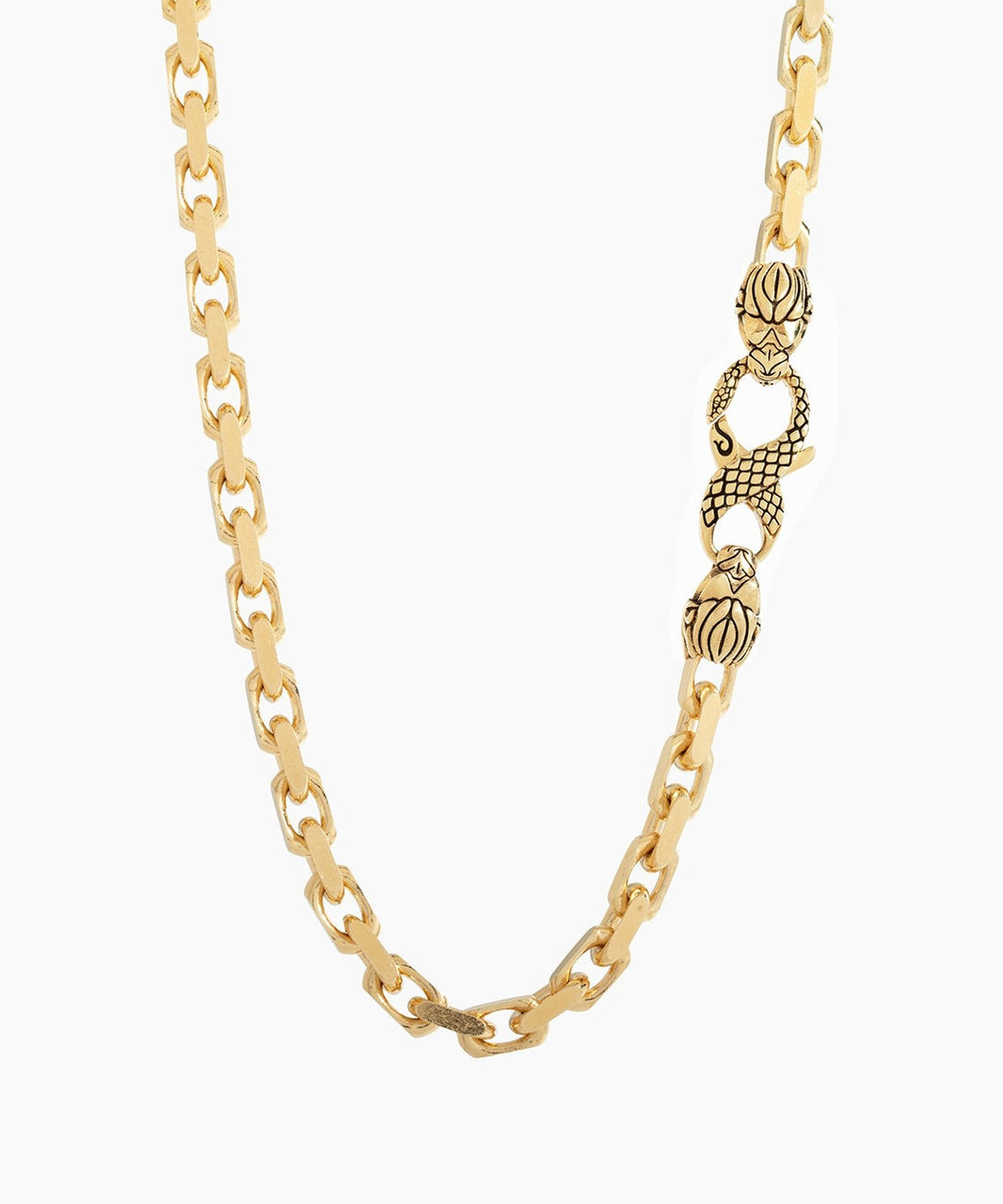
Our Lion and Snake Signature Clasp on a 4mm 14k Diamond Cut Franco chain.
When you buy a gold chain from us, the listing gives you the karat, the width and the weight for every length, the chain is stamped with its karat, and it ships with a certificate of authenticity. It's also covered by our Lifetime Limited Warranty.
Does Real Gold Tarnish?
Pure gold doesn't tarnish. The other metals mixed into karat gold can discolor a little over time, especially in lower karats, and sweat, perfume and chlorine speed it up. Real 14k and 18k gold rarely tarnish in normal wear. We go into more detail in our guide to 14K vs 18K gold.
So can real gold turn your skin green or black? Occasionally, yes, especially in lower karats, so a mark on your skin isn't proof of a fake. But a chain that leaves marks every time you wear it is worth getting tested.
Is White Gold Real Gold?
Yes. White gold is real gold, mixed with white metals and usually plated with rhodium for a bright white finish. A 14k white gold chain has the same gold content as a 14k yellow one; only the other metals in the mix change, and the warm tone you see when the rhodium wears thin is the gold alloy itself.
If you'd rather have a white metal with no plating to wear, look at our platinum chains.

Solid gold chains: heavy for their size, and stamped with their karat.
FAQ
Can gold be fake if it says 14K?
Yes. Anyone can stamp "14K" on a chain. Check that the weight makes sense for the chain's size, look for wear at the clasp, and if you're still unsure, have a jeweler test it.
Does gold stick to a magnet?
No. Gold isn't magnetic, so a solid gold chain won't stick to a magnet. The clasp may tug a little, because many clasps have a small steel spring inside. If the links themselves stick, the chain isn't solid gold.
Does real gold sink or float?
Real gold sinks. So do brass, copper and steel, the metals most fake chains are made of, so the float test can't tell you if gold is real.
Can vinegar tell you if gold is real?
No. Real gold won't react to vinegar, but most fakes won't either, so vinegar can't tell you if a chain is real gold.
Is a hollow gold chain real gold?
Yes. A hollow gold chain is real gold with an empty center, so it's lighter and cheaper than a solid chain of the same size. Under the FTC's Jewelry Guides, a hollow chain should never be called "solid."
What's the most accurate way to test a gold chain?
The most accurate test is a fire assay, but it destroys a small sample of the metal. For a chain you want to keep wearing, an XRF test at a jeweler is the best option, because it doesn't scratch or mark the chain.
Still Unsure?
Have a chain you're not sure about, or deciding between two? Shoot us a message and tell us what you've got. We'll tell you what we'd check. And if you're shopping for a solid gold chain, browse our men's gold chains collection; every product page lists the weight for each length.